
Correlation refers to the average relationship between two variables and the correlation coefficient is the measure of 1) the degree to which the two variables are related, and 2) the direction of that relationship. There are different types of correlation coefficients including Pearson product-moment correlation, point-biserial coefficient, spearman rho coefficient, and phi coefficient. The specific type of coefficient you would you depends on the data and the nature of the question being asked.
The most common measure is the Pearson product-moment correlation. In fact it is so common that specified otherwise a correlation being reported is probably the Pearson correlation coefficient.
Say I have two variables, x: minutes in the sun, and y: severity of sunburn. I would expect there to be an association between the two in that on average, as the number of minutes in the sun increases, so too should the severity of sunburn.
But note that I should probably not expect a perfect relationship between the two because not everyone will burn at the same rate. Some people are darker skinned and require a greater amount of time in the sun before they begin burning; likewise other people are light-skinned for whom a burn begins to occur quickly. When we say that there is a correlation between two variables what we mean is that on average, as the values on one variable go up, values on the other variable also go up. On average, as the amount of time in the sun goes up, the severity of an individual’s sun burn will also increase. Some individuals by more or less but on average the relationship will hold.
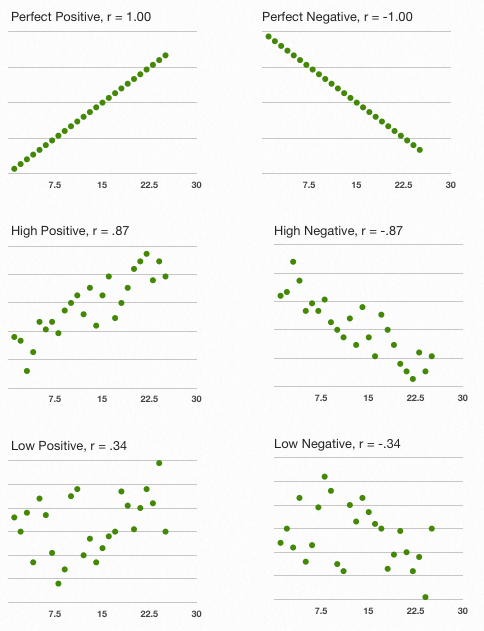
Correlations can be positive or negative. The scatter plots down the left side of the next page depict positive relationships.
 An example of a negative relationship is between exercise and body fat. On average as people exercise more, their amount of body fat decreases. Again, there will be variation across individuals but correlations describe relationships on average. The scatter plots down the right side of the next page depict negative relationships.
Correlations can also describe the strength of a relationship. Correlation coefficients vary from -1.00 to +1.00. A coefficient of +1.00 indicates a perfect positive relationship. A coefficient of -1.00 indicates a perfect negative relationship. A coefficient of 0 indicates the absence of any relationship.
And of course, don’t forget, correlation does not imply causation. It’s so easy to forget yet so crucial to remember!!
 Information Intelligence