

I often read and hear that people are living longer these days, that the average life expectancy has increased dramatically over the past 100 years or so. But this does not mean that in 1900 people were tending to drop dead by age 50.
Life expectancy is typically expressed in terms of life expectancy at birth (LEAB). LEAB has indeed gone up but that’s because childhood mortality has gone down.
Consider the table below*, which shows the average number of years remaining given a person’s age across the decades from the 1930s to 2014 for both sexes and all races. At birth (age 0), the average person born in the U.S. in 1930 could expect to live only 59 years. By 2014, that had increased to 79 years. That is a dramatic improvement. But now consider someone at age 40. In 1930, a person who had made it to age 40 could expect to live to age 70, whereas on average in 2014 that rose to about 80 years. Someone who made it to 80 on average, made it to 89.
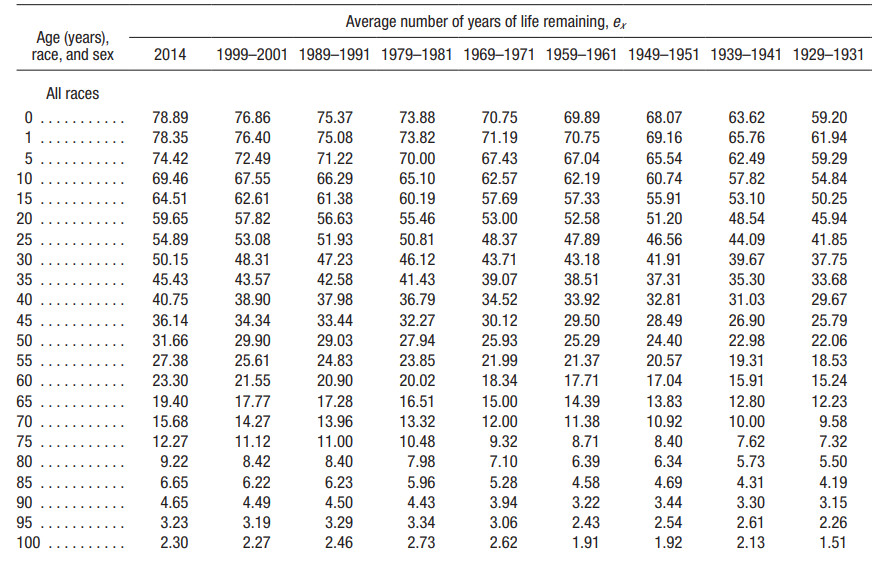
So, yes, at birth the average expected lifespan has increased substantially over the past century but for those who made it to middle age, lifespan has increased more modestly.
*From the National Vital Statistics Reports, Volume 66, Number 4 (August 14, 2017), p. 52. https://www.cdc.gov/nchs/data/nvsr/nvsr66/nvsr66_04.pdf

 Information Intelligence